Please feel free to use all of the information in this Blog.
Although there are several types of satanic images and symbols hidden in the Jehovah's Witnesses' publications, in this blog we will focus exclusively on mirroring images.
These are made up of halves of evil faces that are hidden within the most pieces of art in Jehovah's Witnesses publications. To reveal these demonic images, you have to take some of the Jehovah’s Witnesses’ pieces of art and place a mirror at a specific place inside the selected picture, creating new images composed of one-half of each piece viewed forward and backward at the same time. And when viewed in this way, the new images formed contain composite images that resemble demons’ heads, beheaded men, tortured faces, and psychedelic shapes suggestive of madness and evil.
We will begin with the piece of art found on page 27 of The Watchtower magazine, issue August 15th, 1993:
To reveal this hidden image all that has been done is to take this piece of art, as it is in the magazine, and place a mirror in a specific place within it, thus creating a new image composed of half of the painting seen forward and backward at the same time.
The new image that is formed resembles the head of a demon or devil. A kind of "familiar spirit" also appears floating above the head of this devil, and there is also a couple of women observing, as if they were witches, the demon:

This scene brings to our mind the painting called El Aquelarre (The Coven) by the Spanish painter Francisco de Goya:
A Coven was a secret meeting of witches that took place at regular intervals during the Middle and Modern Ages. These meetings were generally held in the forests, and were carried out in a very peculiar way. The chief of the witches and warlocks, who presided over that said Meeting, usually disguised as a ram or a goat (which is why Francisco de Goya's paintings about covens show a humanoid ram as the central character).
Let's see more satanic images hidden in Jehova's Witnesses' art:
Page 9 of “The Watchtower” magazine, issue March 15, 1996:
To reveal the hidden face, you have to place a mirror on the left edge of the red square:
As you can see, to reveal the head of this demon all you had to do was to take this piece of art and place a mirror in a specific place within it, thus creating a new image composed of half of the painting seen forward and backward at the same time:

The amazing three-dimensionality of some of these images was explained at the time by those who first developed them. The explanation was simple and, at the same time, intriguing; the artists used real models. I will illustrate this statement using the following piece of art from page 35 of the book “The KNOWLEDGE that leads to everlasting life”: 
If we rotate the image 180º and place a mirror on the left edge of the yellow square, we will obtain this form that represents a demon called Cthulhu: Cthulhu is a cosmic demon created by writer H. P. Lovecraft and first introduced in the short story “The Call of Cthulhu”, published in the American pulp magazine Weird Tales in 1928.
Cthulhu’s head is depicted as similar to the entirety of a gigantic octopus, with an unknown number of tentacles surrounding its supposed mouth. Compare a common depiction of Cthulhu’s face with the mirroring image we found on page 35 of the book “The knowledge that leads to everlasting life”:
The level of detail, and realism, of the discovered image far exceeds that of the drawing. The eyes formed by Jesus' face denote a deep malignancy. Two of its horns stand out above the other two, in order to express unequivocally that it is a demon. The shoulders are quite clearly visible, and even part of the arms.
Although it may be difficult to believe, the Watchtower artist was shown, through esoteric rituals, this character as a kind of specter or ghost, but much clearer than a traditional ghost.
The spiritual entity that is shown to the artist is similar to the "familiar spirits" of English witches in the Middle Ages. Let's see how Emma Wilby, British historian, describes familiar spirits:
“…they could manifest as numerous forms, usually as an animal, but sometimes as a human or humanoid figure, and were described as "clearly defined, three-dimensional... forms, vivid with colour and animated with movement and sound", as opposed to descriptions of ghosts with their "smoky, undefined form[s]"" (See page 61 of Cunning Folk and Familiar Spirits: Shamanistic Visionary Traditions in Early Modern British Witchcraft and Magic, written by Emma Wilby in 2005)
These hidden faces, whose eyes look at the reader, fulfill the role of "watchers". In this way they represent the omnipresence of Satan.
Besides that, they are also a sign of ownership or belonging (similar to what wolves do when they mark their territory with their urine).
An analogous example, in which the eyes represent the omnipresence of a divine being, is found on the façade of some Buddha temples:
Another good example, in which the eyes represent the omnipresence of a divine being, is found in the “All-Seeing Eye”; Masonic symbol that represents the “Great Architect of the Universe” (symbolic name with which Masons refer to a god as the first cause of the Universe). In Freemasonry it is considered a symbol of the omnipresent manifestation of the creative principle of the universe.
The All-Seeing Eye on the façade of the Masonic Temple of Santa Cruz de Tenerife
Neither the "Eyes of Buddha" in their temples nor the "All-Seeing Eye" in Masonic temples have anything Satanic or related to witchcraft. In both cases, the eyes represent the omnipresence of a divine being.
The case of the subliminal images of Jehovah's Witnesses is different. The halves of faces that the Watchtower has inserted in its publications serve as "watchers" and are like the "Eyes and Ears of Satan."
Cover of The Watchtower magazine, Nº 6, 2016: 
Page 150 of the book “What Does The Bible Really Teach?”:

What we have here is a “Familiar Spirit” similar in appearance to the Australian reptile Chlamydosaurus Kingii:
It is interesting to note that the brow ridge is much more pronounced in the revealed image than in the real reptile. In that sense, the prehistoric version of Chlamydosaurus Kingii is much more similar to the image discovered, let's see: Now, the reflected image is more humanoid; That is, the face is flatter, its look is more human. In other words, and just as we said at the beginning, what we have here is a “Familiar Spirit.”
The subliminal images in the publications of Jehovah's Witnesses do not have the primary purpose of influencing people's subconscious (although once discovered they could cause nightmares), but rather they are an encrypted satanic cult. These images represent the omnipresence of Satan, and also a sign of ownership or belonging (similar to what wolves do when they mark their territory with their urine). Let's see more examples:
Cover of “The Watchtower” magazine, Study Edition, September 2018:
Cover of The Watchtower magazine, number 1, 2025:
Page 62 of the book “Revelation—Its Grand Climax At Hand!”:
Story 38, page 87, of the book “My Book of Bible Stories”, issue 1978:

Page 31 of “The Watchtower” magazine, issue June 15th, 1989:

The following piece of art that is on the cover of “The Watchtower” magazine, issue June 15th, 2003. This same picture is on page 210 of the book “Draw Close to Jehovah” // on page 16 of “The Watchtower” magazine, issue march, 2011 // and on page page 22 of “The Watchtower” magazine, issue February 15th, 2005:
This piece of art depicts Jesus Christ sitting on a rock, teaching his disciples. The piece of art contains many interesting elements, including a leafy tree behind the Savior.
In this piece of art, the JW.ORG artist has placed half of a demon's face right behind Jesus Christ. To achieve this face, the artist has used the tree behind Jesus. The artist has arranged the leaves of the tree behind Jesus in such a way that half of a demon's face is formed. The entire face can be discovered by placing a mirror on the right edge of the red square:
his face is actually a stylized image of Baphomet. Baphomet was a deity who was worshipped by medieval and modern witches. This image of Baphomet belongs to Eliphas Lévi who created it in the 19th century:

We are therefore talking about an encrypted Satanic cult, which is unknown to most Jehovah's Witnesses.
Since this is a secret Satanic cult, the Watchtower Society's reaction is quite peculiar when it is exposed. Not only do they flatly deny the existence of these images, but they make changes to remove the evidence. That is precisely what they with this piece of art. When it was exposed, JW.ORG modified this figure in a recent publication called “Good News from God to Us” (page 23):

The following artwork is on the cover of the book "Shepherd God's Flock" (edition 2010). This artwork is also on page 7 of the February 1, 1992, issue of "The Watchtower": In 2018, the Watchtower Bible and Tract Society (the publishing arm of Jehovah's Witnesses) released a new edition of "Shepherd God's Flock" with a completely redesigned cover:
Let's see now the following image that is on page 25 of “The Watchtower” magazine, issue March 1st, 2007:
Of course, someone there will say “it is the work of chance” or “chance turned the painting into an image of horror for a fertile imagination”, or perhaps “they are mere accidents by the artist's hand”, but that is not the case. These half faces were inserted intentionally. They are part of an encrypted satanic cult. These characters fulfill the function of "watchers" and represent the omnipresence of Satan (the devil's eyes). In addition, it also constitutes a sign of ownership or belonging (similar to what wolves do when they demarcate their territory with their urine).
Page 8 of “The Watchtower” magazine, issue 2017, number 2:
Page 158 of the book “What Does The Bible Really Teach?”:
The following picture was published in the “Awake!” magazine (in its August 2009 issue, page 23). The same image is on page 39 of the book “Learn From the Great Teacher.” It also appears on page 10 of “The Watchtower” magazine, issue April 15th, 2005. Finally, we can also find it in “The Watchtower” magazine, issue November 1st, 2004 (page 7): 


This image represents a demon known in witchcraft and Satanism as Belphegor. Shared characteristics far outweigh the possibility that they occurred by chance; a protuberant bald head, a large mouth, half-closed eyes, horns, pointed ears, a large nose, and a long beard:
Page 3 of The Watchtower magazine, issue June 1st, 1989:

As you can see, if you place a mirror on the left side of the red square, you will get a ZANGBETO.
A Zangbeto is a kind of costume that resembles a haystack. It is able to fall into a trance which enables its body to be inhabited by spirits. There are no humans under the costume in Zangbeto’s ritual in Benin, only evil spirits.
Now let’s compare the mirroring image with the picture of the zangbeto: The voodoo priest who officiates the ceremony is the only one who can see the Zangbeto’s real form. In the hours after the public ritual, the spirit that inhabits the costume shows itself before the voodoo priest in a secret meeting.
Page 20 of the book “HAPPINESS-HOW TO FIND IT” (1980):


Page 193 of the book “Pay attention to the prophecies of DANIEL”:

By placing the mirror on the right edge of the image, it is clearly observed how the dove transforms into the eyes of a monstrous figure. A kind of Monster of the Black Lagoon. A creature similar to the monster of the movie “The Monster of the Black Lagoon”, horror film of 1954, directed by Jack Arnold:
However, it is important to note that in the mirroring image on page 193 of the book “Let Us Pay Attention to the Prophecies of DANIEL,” the entire lagoon constitutes a kind of living monster, resulting in a much more malignant figure.
As we have already said, these hidden half-faces are part of an encrypted Satanic cult, a form of witchcraft in which they play the role of “watchers.” They thus represent the omnipresence of Satan. It is as if an “all-seeing eye” or “eye of providence” had been inserted into each piece of art.
In addition to representing the omnipresence of Satan, these images also constitute a sign of ownership or belonging (similar to what wolves do when they mark their territory with their urine).
Page 35 of the book “The KNOWLEDGE that leads to everlasting life”:
Page 7 of The Watchtower magazine, issue October 15th, 1989:

As we said earlier, these demons are "watchers" and represent the omnipresence of Satan.
In addition, these images also constitute a sign of ownership or belonging (similar to what wolves do when they mark their territory with their urine). Let's see more examples:
Page 71 of the book “IMITATE THEIR FAITH”, also on page 2 of The Watchtower magazine, issue January 1st, 2011:
Page 118 of the book “What Does The Bible Really Teach?”:
Page 345, chapter 106, of the book “The Greatest Man Who Ever Lived”: 

Page 189 of the book “The Knowledge That Leads to Everlasting Life”. This same piece of art is on the cover of “The Watchtower” magazine, November 15, 1995:
A COMPLEX TOPIC
As you may have noticed, the subject of subliminal images in Jehovah's Witness publications is quite complex. For example, when those who were youngsters in the 1990s look at the reflected image we have just shown (page 189 of the book “The KNOWLEDGE that leads to Everlasting life”) the first thing that comes their mind is a character from the anime Dragon Ball; King Piccolo:

 In fact, there are several common points between these two images: the antennae, the fangs, the eyes and the pointed ears. Some anime fans might find even more common ground between these two images. Pay attention to the drool that runs from the mouth of King Piccolo in the following scene, and compare it to the mirroring image we are examining:
 Drool runs from Piccolo Daimaku's mouth because he procreates children by means of eggs that he expels from his mouth.
Here the question arises by itself; why are there so many points in common between these two figures? The truth is that both were inspired by a character from the film “The Exorcist II” (1973). Almost at the beginning of this film we see how the young Kokumo is possessed by a demon called Pazuzo. The man seen in the photo, disguised as a lobster, is Kokumo now an adult. This disguise identifies him as the head sorcerer, the witch doctor, the incarnated god. Kokumo can spit eggs from his mouth. In fact, he says: “If Pazuzu comes for you, I will spit a leopard”:  This "leopard" also appears in the mirroring image we are talking about. Do you see the strange face below the demon's mouth?
Page 17 of The Watchtower magazine, issue January 1st, 1995:

Cover of “The Watchtower” magazine, March 1st, 1995: 

The following artwork is on the cover of the book "Shepherd God's Flock" (edition 2010). This artwork is also on page 7 of the February 1, 1992, issue of "The Watchtower":
In 2018, the Watchtower Bible and Tract Society (the publishing arm of Jehovah's Witnesses) released a new edition of "Shepherd God's Flock" with a completely redesigned cover:
The following piece of art is on page 181 of the book “Learn From the Great Teacher” (2003):

This is a stylized image of a male-goat's head:
In the covens (meetings of witches) during the Middle Ages and modern times, the main witch or warlock (who presided over the meeting) used to dress up as a male-goat.
The Spanish painter Francisco de Goya, who attended some of these sabbaths, made some paintings about these meetings. Let’s look at one of them called, precisely, “The Coven”:
Did you notice the humanoid features of the male-goat? This male-goat is actually the main witch (or warlock) disguised as a male-goat, presiding over the meeting.
Compare the head of this male-goat with the image we have just revealed:
Page 35 of the book “The Knowledge That Leads to Everlasting Life”:
THE RAM AND THE MALE-GOAT
According to British anthropologist Margaret Murray, two of the most frequently used costumes by the head warlock, to lead the covens during the Middle Ages and the Renaissance times, were those of a ram and a male-goat: 
This is because, for witches, these costumes were reminiscent of the ancient pagan gods Pan (Greek) and Ammon (Egyptian).
In Chapter 1 of her book The God of The Witches, Margaret Murray describes the Greek god Pan in this way: “Of the horned gods of the mainland of Greece, Pan is the best known to the modern world... His universality is shown by his name, which points to the time when he was the only deity of his own locality. All representations of him are necessarily late, after the fifth century B.C.; but even in the earliest forms his characteristics are the same: the long, narrow face, the pointed beard, the small horns, and the goat's legs.” And she describes the Egyptian god Ammon in this way: “The chief of the horned gods of Egypt was Amon, originally the local deity of Thebes, later, the supreme god of the whole country. He is usually represented in human form wearing the curved horns of the Theban ram.”
Medieval witches created a kind of syncretism. They clothed Satan (their god) in the appearance of these pagan gods, and thus concealed a religion that was, in reality, "The Church of the Devil." Medieval and Renaissance witchcraft were the church of the devil.
According to Margaret Murray, witchcraft managed to infiltrate the kingdoms and Christianity of that time. An example of this were the human sacrifices carried out by the priest Étienne Guibourg to favor some members of the French court in the 17th century.
Page 52 of the book “What Does The Bible Really Teach?” (2005):
To understand this image we must first recall the description of the Greek horned god Pan by British anthropologist Margaret Murray: “All his representations are necessarily late, after the 5th century BC; but even in his earliest forms his characteristics are the same: long, narrow face, pointed beard, small horns and goat legs.” (The God of Witches, chapter 1). During the Middle Ages and modern times, European witches syncretized the devil with this Greek deity.
A very interesting detail is the color of the eyes of this devil; they are yellow, like fire. To understand the reason for this, it will suffice to quote a small paragraph from the horror novel “Rosemary’s Baby.” On page 56 of that book, the moment when Rosemary opens her eyes and sees the eyes of the devil is recounted: “She opened her eyes and looked into yellow furnace-eyes, smelled sulphur and tannis root, felt wet breath on her mouth, heard lust-grunts and the breathing of onlookers. “This is no dream”- she thought - “This is real, this is happening.” Protest woke in her eyes and throat, but something covered her face, smothering her in a sweet stench.” (Rosemary’s Baby, chapter 8, page 56)
The following piece of art is on page 16 of the “Awake!” magazine, issue April 2011:
By turning the image 180° and placing the mirror on the right edge, you get the head of a Ram. As we saw before, the ram costume was one of the most used by the main warlock to lead the covens (meetings of witches) in the Middle Ages and modern times.
The following image is on page 18 of The Watchtower magazine, issue January 15th, 1997. It shows a Bible open to the first chapter of Genesis. You don't need to use a mirror here, just look at the image:
Of the millions of species of animals that exist, look at what the Watchtower has placed in the center of this page; the ram. Do you think this animal was placed here by accident?
Página 190 del libro “¿Qué Enseña Realmente la Biblia?”:
¿Se fijó como la oreja derecha del elefante se convierte en los ojos de uno de los demonios?
The following image is on page 16 of the “Awake!” magazine, issue February 22, 2000:
Page 30 of the book “What Does The Bible Really Teach?” (2005): 

Page 17 of the "Awake!" magazine, issue April 2011:
Page 6 of the book “What Does the Bible Really Teach?”:
Chapter 88, of the book “The Greatest Man Who Ever Lived”: 

Page 35 of the book “The Knowledge That Leads to Everlasting Life”:
Page 25 of “The Watchtower” magazine, January 1st, 2008:
Page 38 of the book “What Does the Bible Really Teach?” (2005):

Page 9 of “The Watchtower” magazine, issue March 1, 2014:
Page 187 of the book “What Does the Bible Really Teach?”:
Page 21 of “The Watchtower” magazine, issue January 15th, 2015:
MALEFICENT
The following piece of art is on the cover of "The Watchtower" magazine, issue January 1, 2011:
Compare this mirroring image with "Maleficent"; The evil Witch of the "Sleeping Beauty" story:

Here you are a familiar spirit over the head of a fairy or witch:
Below is a scene from the movie Maleficent where you can see her familiar spirit; Diaval:
Page 12 of the book “What Does the Bible Really Teach?”:

Cover of “The Watchtower” magazine, October 1st, 1995:

These strange mirroring images started being inserted in Jehovah’s Witnesses’ publications after 1975. Why?
At the end of 1975 many Jehovah’s Witnesses left the organization and never returned. These thousands of Jehovah’s witnesses left the Watchtower Society because of the false prophecy given by the Governing Body. They predicted that Armageddon and the end of the world would come in 1975. It didn’t happen.
The attack that suffered the Watchtower from within was very serious. It was expected, as their young members had abandoned their studies for preaching door-to-door an Armageddon that never came. Other Jehovah’s witnesses had also quitted their jobs waiting for the impending apocalypse.
In order to survive and to preserve its great wealth, the Watchtower elite made a Deal with the Devil.
Page 3 of “The Watchtower” magazine, study edition, issue June, 2016:
Page 7 of The Watchtower magazine, issue February 1st, 1995:

Page 75 of the book “What Does The Bible Really Teach?”:

THE HEADLESS MAN: The following piece of art is on page 16 of the “The Watchtower” magazine, issue August 15th, 2007:

Page 6 of the book “Life, How Did It Get Here? By Evolution or by Creation?”: 
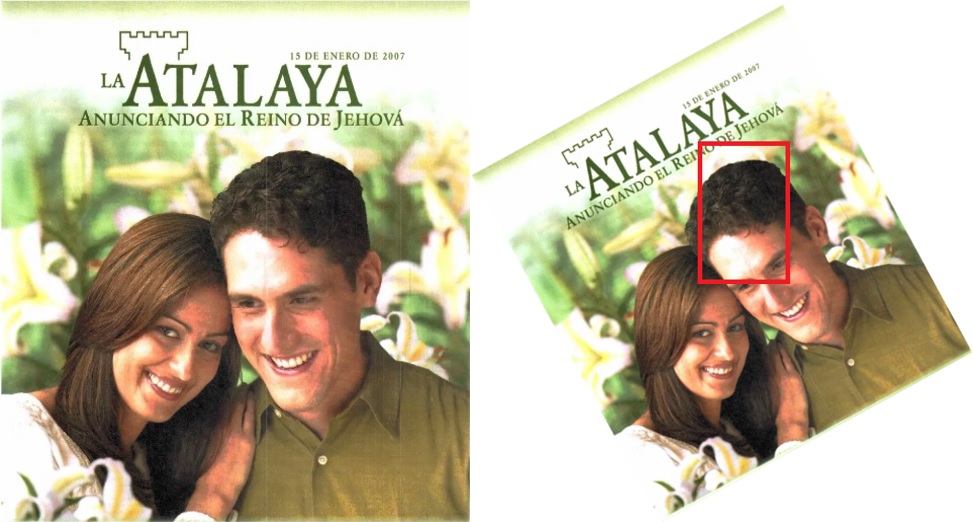
Cover of “The Watchtower” magazine, January 15th, 2007:
“What Does the Bible Really Teach?” (chapter 1, page 9):
The following picture can be found in several Watchtower publications (e.g. page 3 of “The Watchtower” magazine, issue March 15th, 2003 // 16 of “The Watchtower” magazine, issue March 1st, 2012 // page 32 of “Awake!” magazine, issue January 2012 // page 230 of the book “Draw Close Jehovah”// page 18 of the watchtower magazine, issue February 15th, 2006):

This image depicts the crucifixion of Jesus Christ. Now place a mirror on the right side of the red square and you’ll get an incredible mirroring image:  However, there is another mirroring image hidden in this piece of art (on page 11 of “The Watchtower” magazine, issue May 1, 2014, and in the book “Draw Close to Jehovah”, page 230). Place a mirror next to the stake and the face of a demon will appear in the clouds. You can see the “mouth” of this demon right next to Jesus’ knees:
Page 3 of the book “What Does the Bible Really Teach?”:
Cover of “The Watchtower” magazine, October 2019:

THE OPEN HEAD
Story 9 of "My Book of Bible Stories", First Edition (1978):

Cover of “The Watchtower” magazine, March 1st, 2007:

Story 12 of "My Book of Bible Stories", First Edition (1978):


 Cthulhu is a cosmic demon created by writer H. P. Lovecraft and first introduced in the short story “The Call of Cthulhu”, published in the American pulp magazine Weird Tales in 1928.


 Compare this mirroring image with the head of the Alien from the movie "Alien: The Eighth Passenger" and with the head of Pui Pui (extraterrestrial in Dragon Ball Z):


 The voodoo priest who officiates the ceremony is the only one who can see the Zangbeto’s real form. In the hours after the public ritual, the spirit that inhabits the costume shows itself before the voodoo priest in a secret meeting.


 In fact, there are several common points between these two images: the antennae, the fangs, the eyes and the pointed ears. Some anime fans might find even more common ground between these two images. Pay attention to the drool that runs from the mouth of King Piccolo in the following scene, and compare it to the mirroring image we are examining:
 Drool runs from Piccolo Daimaku's mouth because he procreates children by means of eggs that he expels from his mouth.
 This "leopard" also appears in the mirroring image we are talking about. Do you see the strange face below the demon's mouth?